
Scaling AI-based weather forecasting to help millions of smallholder farmers make better planting and irrigation decisions.
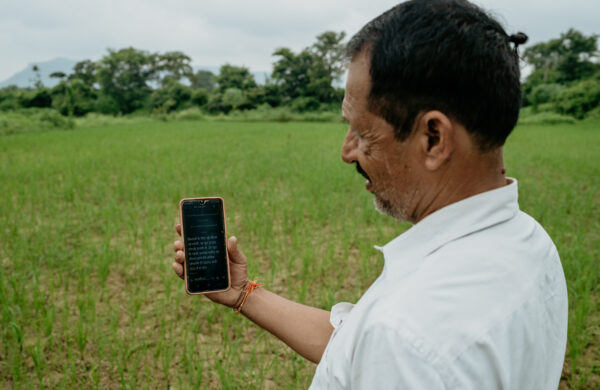
We partnered with the Development Innovation Lab at the University of Chicago to scale AI-based weather forecasting services to millions of farmers across Asia, Africa, and Latin America.
Grant Description
We are supporting an initiative at the Development Innovation Lab at the University of Chicago focused on scaling up delivery of accurate, actionable weather forecasts for farmers in low- and middle-income countries to inform their planning and decision-making.
Advances in AI-based forecasting now allow for faster, more accurate, and lower-cost forecasts than traditional methods, and evidence shows that when farmers receive reliable forecasts, they change planting, input, and irrigation decisions in ways that increase productivity and reduce losses. Building on prior collaboration with the Government of India, where the government sent forecasts to 9 million farmers in 2024, the University of Chicago is working with governments and multilateral development banks, including the Asian Development Bank, to scale these services. Through these partnerships, the initiative aims to reach about 75 million farm families across Asia, Africa, and Latin America.
This grant reflects WAM Foundation's interest in funding interventions where an upfront investment has the potential to unlock outsized, self-sustaining impact, particularly when there is strong evidence that the intervention improves outcomes and offers a clear path to scale through government and multilateral partners.
Multiple randomized controlled trials across India, Benin, Colombia, and Pakistan find that farmers meaningfully change planting, input, and irrigation decisions in response to accurate weather forecasts, with estimated benefits ranging from $5 to $356 per farmer per year. The World Bank has indicated interest in integrating forecasting into programs across 12 countries in sub-Saharan Africa. This grant aims to fund the outreach, benchmarking, and A/B testing needed to shape how those large resources could be deployed in the future.